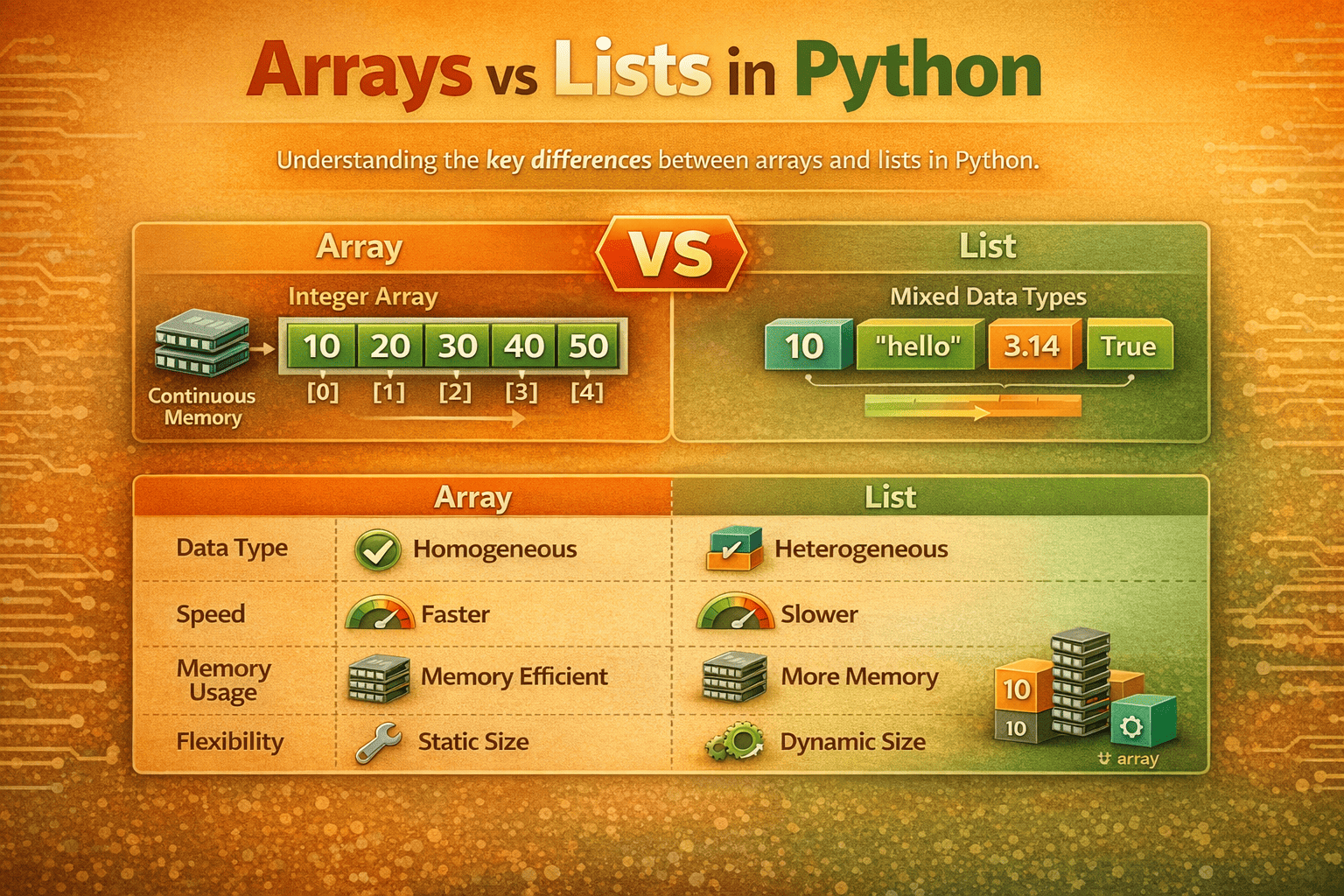

In the realm of programming, data structures play a pivotal role in determining the efficiency and performance of applications. Two of the most commonly used data structures are arrays and lists. Understanding the differences between Array vs List is crucial for developers to make inform decisions about which information construction to use in various scenarios. This blog post delves into the intricacies of arrays and lists, equate their characteristics, use cases, and execution implications.
What is an Array?
An array is a collection of elements place by index or key. These elements are typically of the same datum type and are store in neighboring memory locations. Arrays are widely used in programming languages like C, C, and Java. The primary advantage of arrays is their simplicity and efficiency in access elements.
What is a List?
A list, conversely, is a more pliant data structure that can dynamically modify in size. Lists are normally used in languages like Python, JavaScript, and C. Unlike arrays, lists do not require a limit size and can turn or shrink as needed. This flexibility makes lists idealistic for scenarios where the figure of elements is not known in progression.
Array vs List: Key Differences
To understand the Array vs List debate better, let s explore the key differences between these two data structures:
- Size: Arrays have a set size, meaning the turn of elements must be stipulate at the time of creation. Lists, however, can dynamically resize, allow for the improver or removal of elements as postulate.
- Memory Allocation: Arrays apportion memory in conterminous blocks, which can be more effective in terms of memory usage. Lists, however, may use more memory due to the overhead of managing active resizing.
- Performance: Arrays generally offer better performance for read and write operations due to their contiguous memory allotment. Lists, while more flexible, may incur performance overhead due to dynamical resize and memory management.
- Use Cases: Arrays are worthy for scenarios where the size of the data set is known and fasten. Lists are ideal for scenarios where the size of the data set can change dynamically.
Performance Comparison
When it comes to performance, arrays and lists have distinct advantages and disadvantages. Let s break down the performance aspects of both data structures:
Access Time
Arrays proffer perpetual time complexity, O (1), for accessing elements because they are store in contiguous memory locations. This makes arrays extremely efficient for read and write operations. Lists, however, may have a somewhat higher access time due to the overhead of handle active resize and memory allocation.
Insertion and Deletion
Inserting or deleting elements in an array can be time consuming, specially if the elements take to be shifted to maintain contiguous memory parceling. This operation has a time complexity of O (n) in the worst case. Lists, conversely, are more effective for introduction and excision operations, with a time complexity of O (1) for add or remove elements at the end of the list.
Memory Usage
Arrays are broadly more memory efficient because they apportion memory in conterminous blocks. Lists, however, may use more memory due to the overhead of managing active resizing and memory allocation. This can be a consideration in memory restrain environments.
Use Cases for Arrays and Lists
Choosing between arrays and lists depends on the specific requirements of your application. Here are some mutual use cases for each data structure:
Arrays
- Fixed Size Data Sets: Use arrays when the size of the datum set is known and fasten. for case, store a doctor act of elements in a matrix or a transmitter.
- Performance Critical Applications: Arrays are suitable for execution critical applications where fast access times are all-important. for representative, real time datum process or gaming applications.
- Memory Efficient Storage: Use arrays when memory efficiency is a priority, and the data set size is known in approach. for illustration, storing orotund arrays of numeric data in scientific figure.
Lists
- Dynamic Data Sets: Use lists when the size of the data set can change dynamically. for representative, maintaining a list of user inputs or a queue of tasks.
- Flexible Data Structures: Lists are ideal for scenarios where the information structure needs to be flexible and adaptable. for example, implementing a stack or a tie list.
- Ease of Use: Lists are mostly easier to use and cope, especially in languages that endorse dynamic arrays. for representative, using Python lists for general purpose data storage.
Examples in Different Programming Languages
Let s look at some examples of arrays and lists in different programming languages to instance their usage:
C
In C, arrays are defined using the following syntax:
int arr[5] = {1, 2, 3, 4, 5};
For lists, C provides the Standard Template Library (STL), which includes thestd::vectorclass:
#include std:: vectorvec {1, 2, 3, 4, 5}; Python
In Python, lists are defined using square brackets:
my_list = [1, 2, 3, 4, 5]
Python also supports arrays through thearraymodule, which is useful for numerical data:
import array
my_array = array.array(‘i’, [1, 2, 3, 4, 5])
Java
In Java, arrays are delimitate using the following syntax:
int[] arr = {1, 2, 3, 4, 5};
For lists, Java provides theArrayListclass in thejava.utilpackage:
import java.util.ArrayList;
ArrayListlist new ArrayList (); list. add (1); list. add (2); list. add (3); list. add (4); list. add (5);
When to Use Arrays vs Lists
Deciding between arrays and lists depends on the specific requirements of your application. Here are some guidelines to assist you get an informed decision:
- Use Arrays When:
- The size of the information set is known and fixed.
- Performance is critical, and fast access times are essential.
- Memory efficiency is a priority.
- Use Lists When:
- The size of the datum set can modify dynamically.
- Flexibility and ease of use are important.
- The information construction needs to be adaptable to changing requirements.
Note: It's important to consider the trade offs between performance, memory usage, and flexibility when choosing between arrays and lists. In some cases, a hybrid approach may be necessary, using both information structures in different parts of the application.
to summarize, understanding the differences between Array vs List is all-important for developers to get informed decisions about which datum construction to use in various scenarios. Arrays offer specify size, memory efficient storage with fast access times, make them ideal for performance critical applications. Lists, conversely, provide dynamic resizing and flexibility, making them suitable for scenarios where the size of the information set can vary. By cautiously considering the requirements of your coating, you can choose the right information structure to optimize performance and efficiency.
Related Terms:
- departure between array and list
- array vs list c
- list and array in programme
- array vs link list
- list of array python
- array vs arraylist